From the Book
The Man on the Other Side of the Lake
From a kitchen overlooking Lake Wakatipu, a man looks back at the different lives that brought him to Queenstown - lawyer, migrant, dishwasher, chef, driver, meditator and writer.
The opening of The Older Brother - A Memoir of Migration, Reinvention, and Freedom. Published here in full.
Prologue
The Man on the Other Side of the Lake
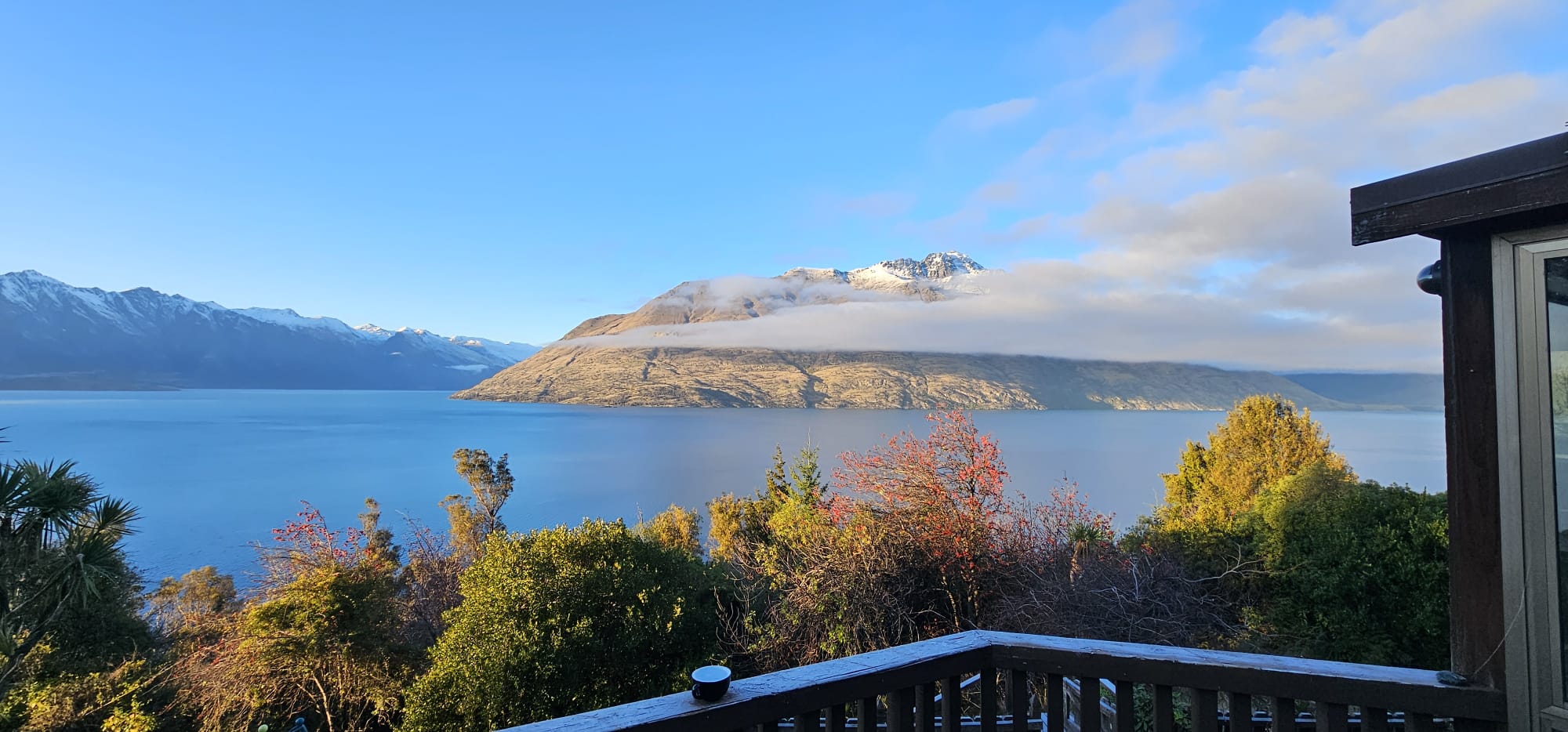
Today, the clouds hide the mountains, or at least they try. Some sit halfway down Cecil Peak and The Remarkables across Lake Wakatipu, covering most of the range while a few snow-covered peaks catch the pale winter light above them. The view looks like a canvas or a well-captured photograph. This is what I can see from the windows of my kitchen in Queenstown. The lake looks blue and almost still, moving just enough to disturb its reflection. In the back garden, near the house, the last red leaves of autumn stand against the water, and the wet deck shines with frost on this cold morning.
Behind me, an old, second-hand coffee machine is finishing its usual noisy ritual. I found the machine in a shop in Te Anau. It is a Breville Roma, probably more than twenty years old, and every morning it sounds as if it may be making its final cup. The grinder has already broken the silence. Now the machine rattles and complains as it pushes hot water through a Colombian blend I found in Arrowtown. Slowly, the coffee fills my cup, leaving a thin layer of golden crema on top. I stop to watch it form, as I always do. Perhaps I simply love coffee. Perhaps I have come to value small rituals that ask nothing of me except a few seconds of attention before the rest of the day begins. Today, I am drinking just a long black.
Downstairs, my laptop remains open in the studio, with this manuscript waiting on the screen. I stepped away to make coffee. The room was empty when we first moved in, but it gradually became the place where I write, record, read, meditate and try to make sense of the questions that have followed me across countries and through several versions of my life. The book came together in much the same way. I began writing it seriously in the autumn of 2026. Before that, I had loose pages scattered across different places. At first, I thought I was simply placing events in order: childhood, university, law, public service, corporate life, migration, kitchens, vessels, relationships and the many times I had to begin again. I wanted to look back honestly and understand how one life had moved through so many forms. The more I wrote, however, the less separate those forms appeared. Writing helped me recognise connections, but it did not complete them. Memories changed when I placed them side by side. An achievement could look different when followed by what it cost; a failure could look different when seen from the life it later made possible. The sequence did not turn the past into a simple lesson. Instead, it made certain questions harder to avoid. The manuscript was no longer only a record of what had happened. It had become a way of asking who had lived through it.
The light falls at an angle that allows me to see my reflection in the kitchen window, suspended over the lake and the mountains. I see a forty-year-old man wearing a blue jumper beneath a woollen vest and a brown knitted beanie. A few curls escape beneath it, and a beard and moustache frame the face I now recognise in the glass. Within that reflection, I can still recognise the executive in suits and ties, the lawyer whose days were filled with meetings, deadlines and decisions. I can see the migrant who arrived in New Zealand with one suitcase and a large backpack. The dishwasher is there too, standing beside a sink in Auckland, surrounded by dirty plates and unable to understand half of what the chefs were saying. I also recognise the chef, the driver, the meditator and the writer who has left his manuscript open downstairs. They all look back through the same glass. I know they belong to the same life. I am less certain that I understand the road between them. If I had to describe the man at the window today, I would use one word: seeker. Someone still trying to understand what happened, what changed and what remains unfinished. Most importantly, he is not looking only at the road behind him. He is also looking at the path ahead.
Queenstown has become the place from which I ask those questions. It is where I work, love, write and imagine what may come next. I did not arrive here with a perfect plan, and very little about my life in New Zealand unfolded as I imagined it would. This place did not give me peace immediately. It gave me long working days, cold mornings, financial uncertainty and the pressures of immigration. It gave me kitchens, vessels and repeated tests of how much I could adapt. Only gradually did it become home, or what I call my base. Even now, life here contains routines, uncertainty and plans that may or may not succeed. The difference is that I am trying to choose as much as possible about what comes next. The mountains, the lake and the changing seasons form the landscape of the life I am creating. Queenstown has given me distance from the life I once knew, and distance has never been simple.
Bogotá is still home too, although in a different way. It is my hometown, even if I no longer expect to live there permanently. My parents are still there, and they are the first people I miss when my mind travels back to Colombia. I last visited in January 2026. From this kitchen, I remember walking through La Candelaria among old buildings, universities, cafés, bookshops and small art stores, where history and ordinary life seemed to share the same streets. I remember Saturday mornings in Usaquén, buying coffee, walking near the park and entering a bookshop without knowing what I might take away. Yet what I miss most is not a particular street or building. It is the feeling that my family and the places that formed the first version of me were close. Bogotá sits high in the Andes, more than 2,600 metres above sea level. From Queenstown, it feels emotionally near and impossibly far away. More than eleven thousand kilometres separate the two places, but migration is not measured only in maps or flight times. It is measured in missed birthdays, family lunches that continue without you, conversations arranged around time zones, and short visits in which you suddenly notice that the people you love have aged while you were busy building a life somewhere else.
I do not regret leaving Colombia, but I do not pretend that the life I created here came without a price. Bogotá and Queenstown do not compete inside me. Bogotá formed me. Queenstown gave me space to become someone I could not yet imagine when I left. One holds my roots. The other holds the life I am building. The difficult part is not choosing between them. It is missing the people who remain on the other side of the world. Perhaps that is one reason the manuscript in the studio became so important. The distance between these two homes is not only geographical. It also contains the years between the child I was and the man at this window.
How did the boy playing beneath a fig tree in Bogotá become the man standing beside Lake Wakatipu? How did the boy whose mother recognised him by the unusual colour on his left arm become a student who believed books might explain the world? How did that student become a lawyer, and the lawyer an executive? How did the executive become a dishwasher? What did the migrant have to lose, learn and rebuild before he could sit here as a driver, meditator and writer, looking back through the glass? I do not have one answer. The manuscript has taught me to distrust answers that arrive too quickly. There are moments I can connect now that once seemed unrelated. There are decisions I understand differently with distance, and experiences whose meaning remains partly hidden. Some changes happened because I chose them. Others arrived through pressure, necessity, accident, love or loss. At times, I moved with confidence. At others, I simply continued because continuing was the only response I knew.
The title of this book came much later. The Older Brother. It may sound like a claim to age, knowledge or authority. For me, it began with one of the most important relationships in my life and gradually came to carry more than one meaning. I will allow those meanings to arrive where they belong. Here, at the window, they remain partly hidden. The coffee machine has fallen quiet. I lift the cup between my hands. The Colombian beans have travelled almost as far as I have to reach this kitchen beside a lake in the South Pacific. The crema has begun to disappear, and the coffee is already cooling. Downstairs, the manuscript waits.
I have spent months trying to understand the man beside this lake, but the story cannot begin with the answers he believes he has found. It must begin before the titles, the departures and the reinventions; before the kitchens, the vessels and this distant home; before I knew there could be more than one version of a life. The mountains remain partly hidden behind the clouds. On the lake, the TSS Earnslaw, a steamship more than a century old, begins its journey towards Walter Peak, as it does every day. To understand the man standing here, I must return to Bogotá, to the morning when his life began.
Keep the conversation going
What did this story bring up for you? Join the conversation on Facebook.
Continue the journey
Explore the story behind these ideas in The Older Brother — A Memoir of Migration, Reinvention, and Freedom.