Notes
What The Older Brother Is Becoming
A newspaper story about a memoir became an unexpected mirror. Looking at The Older Brother from the outside, I began to see how the book, meditation, the Freedom Mission and a growing idea of service were becoming parts of the same life.
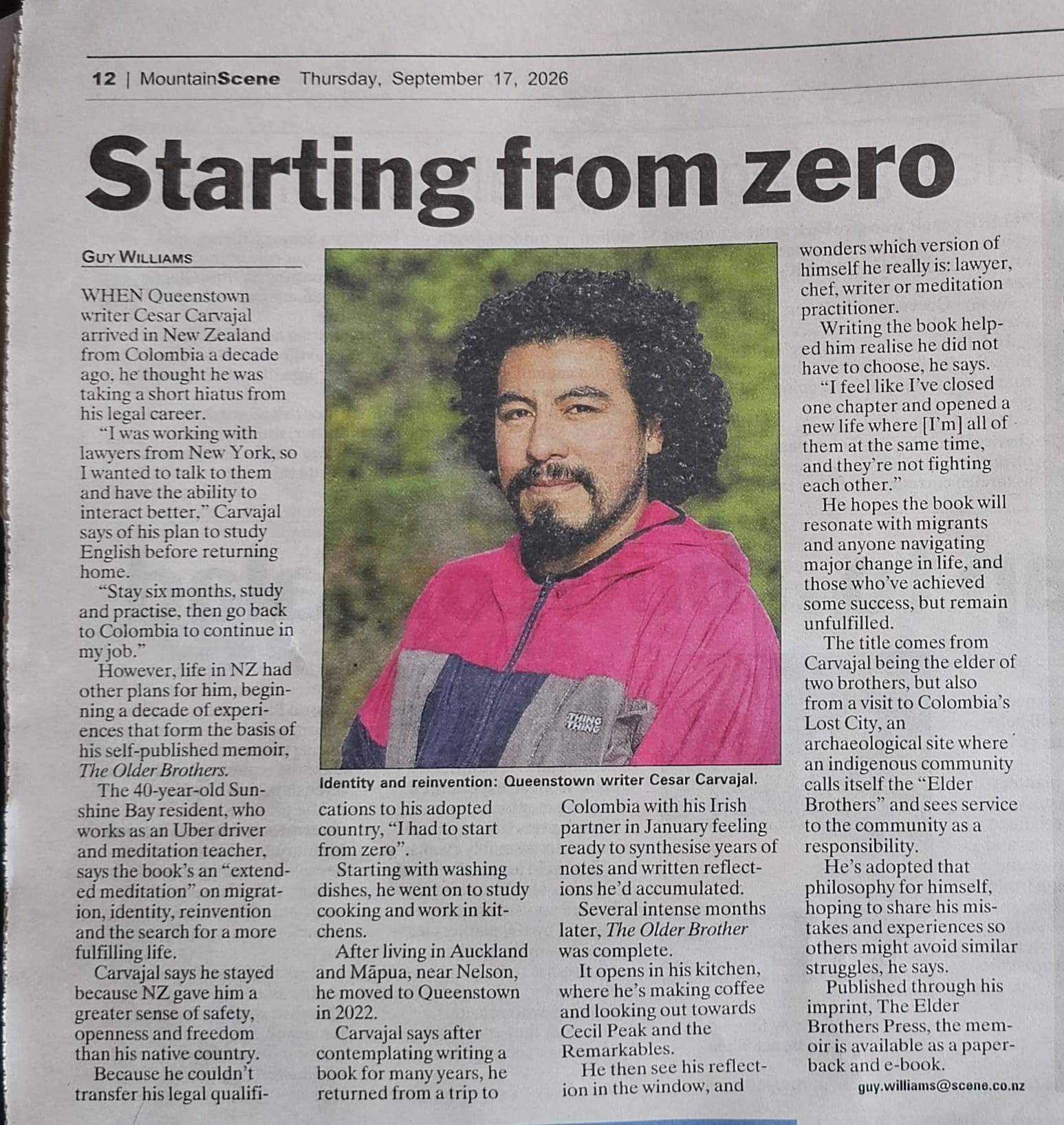
What The Older Brother Is Becoming
A few days ago, I opened the Mountain Scene and found my face looking back at me beneath a headline that seemed almost too accurate: Starting from zero. I had known the article was coming, of course, but holding the newspaper was different from reading a draft or seeing something on a screen. There was something strangely concrete about it. The story that had lived for months inside a manuscript, then inside a book, was suddenly sitting between the local news, advertisements, community notices and everything else that makes up the ordinary life of Queenstown. A story that began years ago in Colombia had somehow found its way into the newspaper of the place I now call home.
The article was about the book, but as I read it I became interested in something slightly different. I was looking at The Older Brother from the outside. For the first time in a while, somebody else had taken the pieces of my life - lawyer, migrant, chef, meditation practitioner, Uber driver, writer - and placed them next to each other. The article mentioned something I had struggled with for years: the question of which version of myself was the real one. Writing the memoir helped me understand that I did not have to choose. None of those lives had disappeared. They were layers of the same person, chapters that had accumulated rather than identities that needed to defeat one another.
Perhaps that is why the article arrived at such an interesting moment. The book has been finished, published and slowly making its way into the world. A few copies are sitting in a Queenstown shop. People who saw the newspaper or my posts have begun asking me directly for copies. Meanwhile, life has continued moving. I am still driving Uber. I am still meditating. I am writing and building new things. Some of those projects are increasingly concerned not only with my own life, but with place, community, stories and the possibility of contributing something useful. Looking at all of this together, I have started to realise that The Older Brother is no longer only the title of a memoir.
The book was the beginning because writing it forced me to look backwards. I had to return to the ambitions I carried when I was young, to the professional identity I once believed would define me, to migration, kitchens, uncertainty, reinvention and all the decisions that slowly moved me toward the life I have now. But once the manuscript was finished, the questions inside it did not disappear. If anything, they became more immediate. What does freedom actually mean once we stop treating it as an abstract word? What deserves our attention? How much of our life do we consciously build, and how much do we simply inherit? What kind of work allows us to remain human while doing it? What do we do with the freedom we manage to create?
Those questions are becoming the territory of what I have started calling The Freedom Mission. It is not a formula for escaping work or a claim that I have discovered some perfect way to live. Most of it is far more ordinary than that. It can mean deciding whether another hour of driving is actually worth more than an hour spent writing. It can mean understanding the economics of flexible work rather than simply reacting to the next notification on a screen. It can mean building something before it makes money, protecting time for the people we love, changing a plan when reality changes, or admitting that sometimes the most intelligent use of an hour is sleep. The Freedom Mission is the external experiment: an attempt to create a little more agency over time, work, money and direction without pretending that any of those things can ever be completely controlled.
Meditation belongs to the same journey, although for a long time I kept it in another compartment. I thought of meditation as a practice I did in the morning, something almost separate from the messier practical questions of work and money. Over the years I have come to understand it differently. Meditation trains attention. It gives me an opportunity to observe the speed at which thought becomes reaction, and sometimes to create a little space between the two. It has made me increasingly interested in awareness, the nervous system, focus, gratitude and the way internal states shape the decisions we make outside the meditation room. Freedom, I am learning, has an internal dimension too. There is little point designing a life with more external choices if every choice is still being made unconsciously.
That is why meditation now has a permanent place inside The Older Brother. I have called it The Meditation Room, because that is how I want it to feel: not another identity that takes over everything else, but a place we can enter and return from. It will hold practices, videos, reflections and eventually some of the in-person work I am beginning to explore again here in Queenstown. Meditation is not the destination of The Older Brother. It is one of the tools. Awareness matters because of what we do with it once we stand up again.
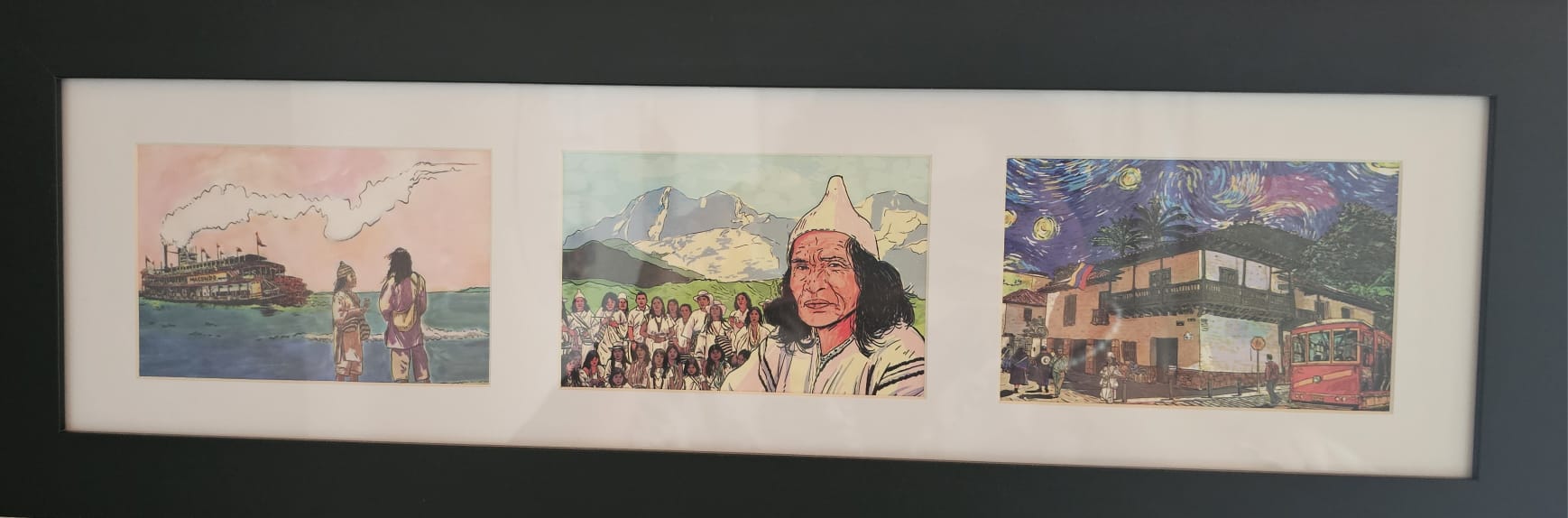
Images I have kept from Colombia, including memories connected to the Sierra Nevada de Santa Marta and the idea of the Elder Brother.
There was another small part of the Mountain Scene article that stayed with me. It mentioned the other origin of the name The Older Brother: a journey I made to Colombia's Lost City and an encounter with the Indigenous worldview of the Sierra Nevada de Santa Marta. The peoples of that territory carry a profound understanding of responsibility toward the land, the community and the relationships that sustain life. The idea commonly translated as the Elder Brother has always stayed with me, particularly the suggestion that knowledge is inseparable from responsibility. To know more is not simply to accumulate something for yourself. It creates an obligation to care, to serve and to consider what your actions mean for the wider community and territory around you.
I have a framed set of images from Colombia hanging in my room. I have looked at them countless times without necessarily analysing why I kept them so close. Recently they have started to mean something different to me. The more I think about freedom, the less interested I am in a version of it that ends with the individual. Personal freedom matters deeply to me. Much of my adult life has involved trying to recover some control over my own direction. But freedom without responsibility can easily become another kind of isolation. At some point the question has to move beyond What kind of life can I build for myself? and become What can I do with that life once I have built a little more space inside it?
That question is beginning to influence several projects I am working on now. I am not ready to explain all of them here, and they need time to develop their own identities before I try to fit them neatly into a philosophy. But they share something important. They are concerned with community, place, stories, participation and the possibility of creating structures that are useful to people beyond myself. In different ways, they are forcing me to think about service not as charity or self-sacrifice, but as contribution: using some of our attention, skills and freedom to strengthen the environments and communities of which we are already a part.
This is perhaps the piece of The Older Brother that is only now becoming visible. For a long time I treated everything separately. The memoir was a book project. Meditation belonged to another part of my life. Uber was simply work. Writing was something I did when there was time. The things I was beginning to build around community seemed to belong somewhere else again. Yet increasingly, when I step far enough back, I can see the same questions moving underneath all of them. How do we become more aware of the life we are actually living? How do we gain enough self-mastery not to be driven entirely by reaction? How do we create meaningful freedom rather than simply escaping obligation? And once we have created some freedom, what are we going to contribute with it?
The architecture of The Older Brother is beginning to reflect that. The book is the story that brought me here. The Meditation Room is part of the inner practice. The Freedom Mission is the external experiment. The Journal is where I try to understand what is happening while I am living it. And somewhere beyond those rooms is an idea of contribution that I suspect will become increasingly important. I do not yet know exactly what shape that will take, and I am becoming more comfortable admitting that I do not need to know everything in advance.
For now, the phrase I keep returning to is conscious modern living. I do not mean a perfectly optimised life, or some fantasy in which every action is intentional and every morning begins with clarity. Modern life is too complicated for that, and human beings are too contradictory. I mean something simpler: learning to notice more, react a little less, understand the systems shaping our behaviour, create more agency where we can, build things that matter to us and eventually turn some of that awareness outward toward other people.
A journey from survival to awareness, self-mastery, meaning and contribution.
Perhaps that is what The Older Brother has been trying to become all along.
I did not sit down with a business plan and invent these different pieces. Most of them arrived separately, sometimes years apart. Only recently have I begun to recognise that they might belong to the same house. Seeing the Mountain Scene article made that clearer. A newspaper story about starting from zero reminded me that rebuilding a life is not something that ends when you finally publish the book about it.
The story continues.
And I think The Older Brother does too.
Keep the conversation going
What did this story bring up for you? Join the conversation on Facebook.
Continue the journey
Explore the story behind these ideas in The Older Brother — A Memoir of Migration, Reinvention, and Freedom.